

News & Updates
Teasers, Excerpts, and Commentaries
Teasers, Excerpts, and Commentaries
- when and where to get TAFoDH!
- plus everything you'll want to know about the book in the upcoming weeks
Teasers, Excerpts, and Commentaries
Teasers, Excerpts, and Commentaries
Teasers, Excerpts, and Commentaries
- enjoy some teasers and excerpts
- read what the authors have to say about them
- questions about TAFoDH? Ask Derek (author), Mark (cover designer), and Jay (publisher)
Interviews & Chat
Interviews & Chat
Interviews & Chat
- read what the authors and book & artwork creators have to say about Dean Harris
Images & Artwork
Interviews & Chat
Interviews & Chat
- covers and cover elements
- see what's what (by whom and why!)
News & Updates
TAFoDH is tracking 4.6 out of 5 on Amazon
On The Air with Florenza: Derek's interview
On The Air with Florenza: Derek's interview

Awarding FIVE STARS...
"This novel makes you think the whole time you are reading – in a good way; a strong spiritual element and it has lots of positive disability representation..."
On The Air with Florenza: Derek's interview
On The Air with Florenza: Derek's interview
On The Air with Florenza: Derek's interview
Derek sat down with Florenza Lee to talk about his writing and The Accidental Future of Dean Harris.
Here are the deets:
Interviews air on:
Main Show: June 26, 2026
YouTube: https://youtu.be/V_EROYfNdmw
SoundCloud: https://on.soundcloud.com/gfNx2BVfoVXHAYJb0q
Intermissions: July 6, 2026
SoundCloud: https://on.soundcloud.com/mbVJE1cYe9TBjH38Q6
YouTube: https://youtu.be/MQKr1ndjViY
Mini-Bites will air during this week on TikTok!
First reader review on Amazon is in!
On The Air with Florenza: Derek's interview
First reader review on Amazon is in!
Awarding FIVE STARS...
"What a great book about writing, reading, and the business of believing in yourself! I really enjoyed this story :)"
Thanks so much, Courtney!
New review from SA Examiner!
Pre-orders for The Accidental Future of Dean Harris OPEN!
First reader review on Amazon is in!
Sandra Cruz at SA Examiner has published her review of The Accidental Future of Dean Harris:
"Insightful and ultimately hopeful, it’s a gentle reminder of the importance of finding meaning not in the future we imagine, but in the life unfolding right before us."
Read TAFoDH's opening pages. The SAMPLE is here!
Pre-orders for The Accidental Future of Dean Harris OPEN!
Pre-orders for The Accidental Future of Dean Harris OPEN!
Scroll down to the Teasers, Excerpts, and Commentaries section for some opening passages (or just click here).
Want the full sample? Request a PDF or ePub version by hitting the button below! (Or email mail@papillon-du-pere.com.)
“The delivery of Dean’s misadventures and literary pursuits assumes an unusual form that invites readers into his perceptions and experiences from its opening lines.”
– D. Donovan, Sr. Reviewer, Midwest Book Review
Pre-orders for The Accidental Future of Dean Harris OPEN!
Pre-orders for The Accidental Future of Dean Harris OPEN!
Pre-orders for The Accidental Future of Dean Harris OPEN!
The Kindle e-book is now available for pre-order, ahead of its Monday June 15 release. The paperback will be available Friday June 12 to order for delivery on (or even before!) publication day.
“What works best here is Dean’s voice. He is funny, self-lacerating, observant, and grandiose enough to stay interesting.”
– Kyle Eaton, Manhattan Book Review [rated 4.5/5]
Manhattan Book Review reflects on Dean's future...
Diane at Midwest Book Review has some words for Dean Harris
Diane at Midwest Book Review has some words for Dean Harris
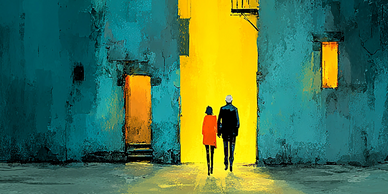
Manhattan Book Review will publish its review of The Accidental Future of Dean Harris.
Kyle Eaton at Manhattan Book Review loves Dean Harris!
Rating the book 4 1/2 out of 5, here's some of what he had to say:
“Derek McFadden’s The Accidental Future of Dean Harris is a novel about artistic ambition that understands how humiliating ambition can feel from the inside. Dean is an unpublished writer, an underpaid literary gatekeeper, a man with cerebral palsy, and the sort of person who keeps building his life around the conviction that the real version of himself is still just ahead. McFadden gives him a nonlinear six-part structure to move through therapy sessions, family history, romantic memory, professional frustration, grief, and the stubborn hope that a future self might still arrive. That structure sounds fussy on paper, but it suits a book obsessed with revision, not only of manuscripts, but of the stories people tell about their own lives.
What works best here is Dean’s voice. He is funny, self-lacerating, observant, and grandiose enough to stay interesting. The novel gets real mileage out of his relationships, especially with Claire, his partner in both emotional survival and the doomed-sounding bakery-bookstore dream Treats and Tomes, and with the older literary champion Charles Corning, who keeps pushing Dean to stop being afraid of the truth in his own work. McFadden is also sharp on the small abrasions of literary culture: unpaid labor, agent rejections, ego disguised as mentorship, and the way talent can curdle into self-protection...
Readers will find this is a smart and emotionally candid novel about art, disability, love, and the dangerous comfort of waiting for your life to begin."
Diane at Midwest Book Review has some words for Dean Harris
Diane at Midwest Book Review has some words for Dean Harris
Diane at Midwest Book Review has some words for Dean Harris
Diane Donovan, senior. reviewer at Midwest Book Review, enjoyed finding out about The Accidental Future of Dean Harris.
"The Accidental Future of Dean Harris is a novel presented in vignettes about a writer who searches for and achieves literary success – only to find that his heart’s desire brings with it a challenge to his ideals of life, death, and achievement.
The delivery of Dean’s misadventures and literary pursuits assumes an unusual form that invites readers into his perceptions and experiences from its opening lines:
We’re seated next to each other, you and me, in a warm, metaphorical train car aboard a sleek, metaphorical train when you stop reading your book, insert a bookmark, glance over, and ask me what I do for work. I’m not sure why you ask. Maybe the temperature invites discourse. I work at all hours, I tell you. Then I realize—in part thanks to the quizzical look on your face—that you aren’t in search of a vague, opaque answer from me. You want more. A real conversation to pass the time.
What Dean does is write. His output syncs with his inner concept of who he is—until everything changes. Derek McFadden chronicles Dean’s evolutionary process in six sections of revelations which are interconnected, but fluctuate in time, place, and considerations. These may challenge readers used to a linear timeline of events and sequential discoveries, but will thoroughly delight in drawing close connections between the visions of disabled Dean, literary achiever Dean, and other incarnations as he considers the courses of his life and impact of both chance and his choices:
A young Dean Harris was impressed but remained appropriately dubious. I didn’t think his Heaven was the real Heaven, but there was a chance Dad and I were unfair years ago in our judgment of the book and the man. If Heaven’s Gate was right, then when I got up there, my palsy would be gone, and people wouldn’t see me as a disabled drain on society (as my drunk stepfather did, and as I too often saw myself). I’d be the writer Dad and I had always known I could be, and folks would demand early access to my latest heavenly releases!
Readers contemplate a plethora of influences, from a father’s relationship with his son to the importance of Dean’s dog,Blackberry, to Dean’s relationship with girlfriend Claire, plus his living with a disability, regrets and self-permission, and more. The dovetailing of personalities, themes, life cycles and encounters, and the ultimate question of whether Dean’s future is truly accidental makes for a thought-provoking journey that considers the ultimate impacts of all kinds of events and choices.
Librarians seeking a literary novel that puts disability and achievement in a different light will welcome how The Accidental Future of Dean Harris builds its characters and revised images of success, failure, and what lies in between.
Its ability to draw with dreams, visions of the future, and revised connections makes for a winning story that is hard to put down."
The review publishes in the July edition of Midwest Book Review.
More soon...
Diane at Midwest Book Review has some words for Dean Harris
More soon...

Check back soon for more news and updates in the coming days and weeks.
Teasers, Excerpts, and Commentaries
SAMPLE: opening passages to TAFoDH

CHAPTER ONE [excerpts]
Rejection will, for all time, stand as the most personal, most painful verdict that can be delivered in all of human experience. The most painful thing about rejection is how it is so commonly as impersonal as a prostate exam and as final as a terminal diagnosis.
It’s not you, it’s us. But it is also sort of mostly you.
We loved your idea, and we know you worked hard coming up with it, but we didn’t love it enough, and we’ve chosen to go in a different direction.
If only you were just a little bit taller.
If only you didn’t have that pesky cerebral palsy of yours …
I was well acquainted with all of these. And, as much as I wanted to, I’d never forget the variant of rejection that was wholly its own thing, the literary kind.
Such a missive arrived e-mail-addressed to me in 2015. By then, I’d come to know rejection well, but I’d not yet professionally rejected anyone. This particular rejection read:
Dear Mr. Harris:
First, thank you so much for submitting your work to me. Your piece had some fine writing in it, a cast of finely wrought characters, and a true heart at its center. Unfortunately [...]
(It’s that unfortunately that no writer wants to see, but—once they’ve seen it—they can’t unsee it for anything.)
[...] while I enjoyed reading your work, I’m afraid it’s not for me. I’m just not sure how I would market this story, and for that reason, I’m going to step aside. I’m sure another agent will feel differently. This is a subjective business. Do not lose heart!
Sincerely,
Caroline Brash
Brash & Braver Literary Agency
That note had come in about thirteen months before my writer-dad got his big break—and I got this job that isn’t exactly a job. Despite Ms. Brash’s assurances that my literary luck would turn, no agent had yet felt differently about my autobiographical novel, the words that darkened the pages that made all my pain make sense to me.
I went through hell so my readers wouldn’t have to, I told myself.
None of the ninety-five other agents I’d queried agreed with me. They were all in Camp Caroline. I wished I could glimpse the future. Not through a crystal ball; such an implement would be far too cliché. But why not, say, a little porthole that could show me something of what was actually to come? I’d been convinced, some time ago, of what that would be; the lexiconic greatness my father and I had believed was awaiting us both, our shared destinies. Dad still held to this belief. For me, it was fading too fast. I’d grown pragmatic as I’d come to understand the business side of publishing, and without such a hopeful view to sustain my dream—the lights through the future’s window winking at me, beckoning me to join them—perhaps I was destined to remain forever a literary leftover of whom publishing declared, in concert: “Close all the gates and bar all the doors! He’s not coming in!”
Continues in The Accidental Future of Dean Harris, available June 15.
More soon...
Check back soon for teasers, excerpts, and commentaries from the authors.
Interviews & Chat
Q&A with Derek about his inspirations for TAFoDH: Part 3
Q&A with Derek about his inspirations for TAFoDH: Part 3
Q&A with Derek about his inspirations for TAFoDH: Part 3
Part 3 of our Q&A with Derek McFadden about his new novel What Death Taught Terrence. Last 2 questions, but they might be the most interesting…
“What do you hope readers will take away from reading The Accidental Future of Dean Harris?
Ah, the $64k question! Well, I guess a feeling of ownership over their own lives, which for many, I think, is getting increasingly hard to wrangle.
For someone born when I was, in the early ’80s, we were told we could be whatever we wanted to be, as long… as we just said “no” and let those pesky economics trickle down. I think now a lot of us know the American dream is, for so many, just that—a dream, a fantasy espoused by boomers who’d seen their parents come home from war to picket fences and 2.5 kids. Many of those same boomers went off to war themselves, but they didn’t come back home to the dream. They got to know disillusionment really well.
I think it’s time that we tackle the lives we’re living and, to the extent that we can, turn them into the lives we want to live. Your future might feel accidental if it’s not the one you saw for yourself at the outset, but there’s really and truly nothing wrong with that. And if your life isn’t the one you want, only you can change it.
Tell us about the novel inside the novel, What Lucas Learned From Life. It feels deliciously meta. What’s going on with that?
I can assure you, Mark Zuckerberg had nothing to do with it! So, I think stories within stories are fun. It’s like tinkering in two separate but connected universes. You can also make points more easily if a writer is your main character and something happens in his real life—otherwise known as the plot. He can transfer that to his story, the meta portion of the narrative. Maybe he sees the connection. Maybe he thinks he came up with a new plot twist out of thin air. Either way, my hope is that the reader sees the connection I intend for them to see. There are times when, as a writer, I want readers to see the seams of the quilt, and there are times when I like to hide them.”
Here more from Derek, here on site, in the coming days and weeks.
Q&A with Derek about his inspirations for TAFoDH: Part 2
Q&A with Derek about his inspirations for TAFoDH: Part 3
Q&A with Derek about his inspirations for TAFoDH: Part 3
We've got 4 more questions and answers today (since it turns out we had 11 questions, not 10!):
"How much outlining did you do before beginning the first draft? Are you a plotter or a pantser?
Definitely a pantser! I know some great authors who are plotters. I find many of them live in genre fiction, which The Accidental Future of Dean Harris is not. I mentioned before I don’t really outline. I write and then I pray to the writing gods to bring me in for a safe landing.
Did the setting of the novel play a significant role in shaping the narrative?
I was about to say “no,” outright. “Next question, please!” I write character studies, so usually my characters are more important than my settings. But this one also takes place in part during COVID, and so that setting couldn’t help but leak into the story. Don’t worry, though. I’m not here to depress you, and neither is Dean!
How do you balance character development with plot progression?
For me, character development is the holy grail of writing. Without character development, you can’t know what your character’s story arc will be, and if they don’t develop, if they don’t evolve, that’s just plain boring.
There are times when plot informs character, though. You know, like, “There’s going to be an earthquake. Let’s see how our characters handle that." For me, though, in most cases, if the character hasn’t been well developed, the reader won’t care what happens to them in a disaster. They’ll just move on to the next book on the TBR, and I can’t blame them.
What themes or messages are particularly important to you in this story?
Hmm, I feel like answering that gets into spoiler territory! I guess the most important feeling I can give you as the author of a work is the feeling I leave you with when you turn the last page—stemming from the message in the last pages of the piece. And all of that stems from the characters and who they are and who they become. Mainly I hope you leave uplifted. (And I hope you recommend the book to others!)"
That’s the 8 of the 11 now wrapped! Check back later in the week for the last 2.
Meantime, if you haven’t gotten your sample yet, either grab it off Amazon by hitting the button below, or mail us for one: mail@papillon-du-pere.com (with the subject line: “TAFoDH sample” and state .pdf or .ePub file).
Q&A with Derek about his inspirations for TAFoDH: Part 1
Q&A with Derek about his inspirations for TAFoDH: Part 3
Q&A with Derek about his inspirations for TAFoDH: Part 1
We posed 10 questions about the writing and creation of The Accidental Future of Dean Harris to author Derek. Here are the first 5 for you to enjoy:
“Tell us about the initial spark for The Accidental Future of Dean Harris. How did the story develop from there?
It was actually “anger”! As my therapist and my partner often note, it’s a secondary emotion—something else sparks the anger itself. I think my dad sent me a particularly annoying text. (Funny thing is, as angry as I was then, I don't remember now what he wrote.)
All this to say that the first part of this novel came out of anger. I will remain eternally grateful to my publisher and editor because, when I showed it to him, he said something along the lines of, “This is great… We can't do anything with it! Build a story and let’s talk.”
I built a story from there, and we talked.
The Accidental Future of Dean Harris is a better book for all the collaborating I entered into while writing it. Readers you trust and editors who refuse to steer you wrong allow for good books, and in this case they allowed me to develop one that, for me is my absolute best.
Did Dean Harris as a character come to you fully formed, or did he evolve during the writing process?
Dean was probably as broken at the beginning of the writing process as I felt. I could not see his full story arc until I saw past my anger. I could not see what this story was going to be until it dawned on me what it needed to be, and that I had the chops to get it done. I had to believe that before I could do it.
One of the authors I've interviewed on my podcast, Writing While Handicapped, the great Sonya Walger (author of Lion, 2025) said to me that, at the end of writing a novel, an author knows exactly how to write that novel but that this almost doesn't help them at all with the next one or the one after that. I think she’s dead on.
The title suggests a strong theme of fate or chance. Can you discuss how those themes are explored in the novel?
I’ve always gravitated to media that explore the idea of a life ending up differently than the protagonist imagined. Think It’s A Wonderful Life, for example. If George Bailey weren’t around, there would have been no Harry Bailey after he fell through the ice, and so many lives would have been adversely affected.
We can’t see the whole picture while we’re in the picture. I think that’s really why this particular story kept gnawing at me like an insistent pup to be told. Dean can’t see the picture, and neither can any of his contemporaries. All they can do is the best they can with what they have and what they know.
All we can do is the best we can. So if a pandemic hits, or the book you worked so hard to get into the world doesn’t sell like hotcakes, how much of that is your fault? And how much of that is just the way the universe felt like expanding that particular day?
I loved writing this book, and one of the reasons is how it explores how much of life is in our control and how so much of it is not.
What was the most challenging part of writing the story?
I think probably not knowing the ending was the toughest part for me. I don’t usually outline, so I often don’t know the endings in my work. But there was definitely a point when I’d written about 200 of the best pages I felt I’d ever cobbled together, and yet the ending just would not come to me. Stephen King said once that an author isn’t paid to begin a novel; he’s paid to finish them. I was genuinely afraid I’d never finish this one. It felt like swimming in a deep lake and realizing you were in trouble. It’s so easy to panic at a moment like that. Then the ever-expanding universe threw me a life preserver. I won’t tell you what that is so as not to spoil the fun!
Are there any particular authors or inspirations that influenced this book?
Oh, yes, sure. I’ve even interviewed some of those authors on my podcasts. None of my interviews, I should note, have ever gone as badly as Dean’s interview with his hero/inspiration goes. My own inspiration for the interview scenes came from a movie you might not have heard of. It’s from 1957 and is called A Face in the Crowd. It stars the great Andy Griffith in one of his few dramatic roles. Check it out.”
That’s the first 5 wrapped! Check back next week for the next 5.
Meantime, if you haven’t gotten your sample yet, either grab it off Amazon by hitting the button below, or mail us for one: mail@papillon-du-pere.com (with the subject line: “TAFoDH sample” and state .pdf or .ePub file).
Derek shares some of his inspiration about TAFoDH
Derek shares some of his inspiration about TAFoDH
Q&A with Derek about his inspirations for TAFoDH: Part 1
We asked Derek for a few titbits about the creation of Dean Harris...
I’ve always been fascinated by the “invisible” versions of our lives—the ones that exist only in our late-night “what ifs.” Dean Harris is a character who represents all of us who have ever looked at a successful stranger and thought, That should have been me.
Writing The Accidental Future of Dean Harris was my way of exploring the gap between the success we chase and the happiness we actually need. I wanted to write a story for anyone who feels like they are currently living in the “draft” version of their life, waiting for the real story to begin. Like the works of Mitch Albom, I hope this book serves as a gentle reminder that our “accidental” moments are often the most meaningful ones.
I can’t wait for you to meet Dean—and perhaps, in his journey, find a little bit of your own map back to the present.
About the author, Derek McFadden
Derek shares some of his inspiration about TAFoDH
About the author, Derek McFadden
Derek McFadden is an author, a poet, a podcast presenter, a radio enthusiast, an unapologetic fan of the Seattle Mariners, and a former March of Dimes ambassador.
He lives with a mild version of cerebral palsy, and his eyes aren’t great at being eyes.
Derek’s acclaimed novel What Death Taught Terrence was a Next Generation Indie Book Award Finalist 2021 and the Best Adult Fiction Winner at The Wishing Shelf Awards 2021. The audiobook version, read by the acclaimed B.J. Harrison, was a Best Adult Audio Book Finalist at The Wishing Shelf Awards 2021.
Derek’s second novel, The Santa Claus Agreement was published in 2022, finally lifting the lid on exactly how Santa Claus works. A Wishing Shelf Awards Red Ribbon Winner, it debuted to rave reviews … just not enough of them. We blame Santa and his conspiracy of silence.
More soon...
Derek shares some of his inspiration about TAFoDH
About the author, Derek McFadden
Check back soon for more interviews and chat with the authors and book creators.
Images & Artwork
Full TAFoDH cover reveal
Full TAFoDH cover reveal
Full TAFoDH cover reveal
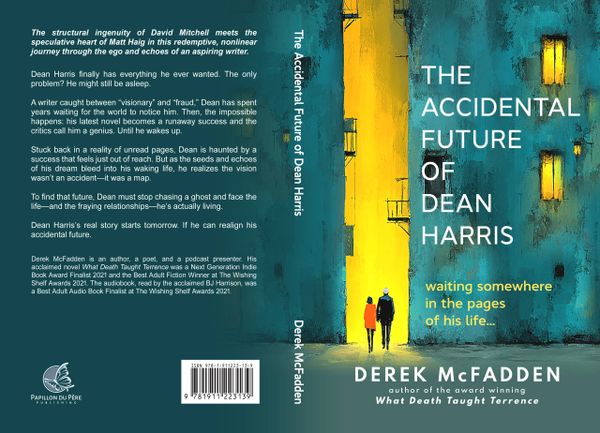
From the front and back again...
You’ve seen only the front cover so far… But now you can get a better idea of the whole cover concept with this flat artwork for the paperback. And for the first time, we can reveal the text on the back cover, too! It's a variation of the text we've done for the online sales pages.
Come and have you say over on our Twitter page, @PapillonPere. Let us know what you think.
TAFoDH's cover revealed!
Full TAFoDH cover reveal
Full TAFoDH cover reveal
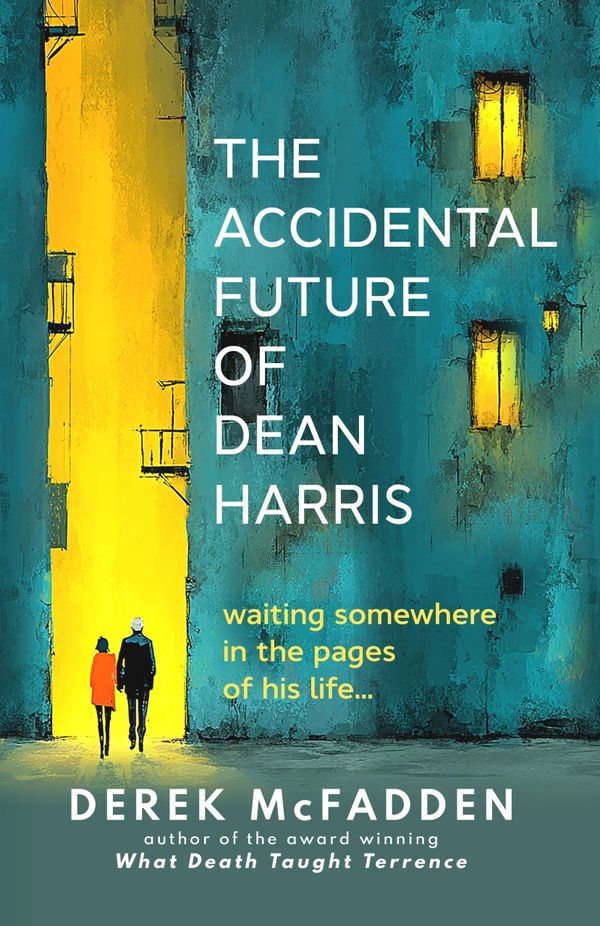
Here it is! The cover literally everyone has been asking to see. Well, almost everyone.. Okay, some folks ;)
It took us a while to get to this choice—and then finalize all the elements—with other versions we developed and rejected.
Check back in the coming days and weeks to see some of the rejected cover versions and find out why they were abandoned. And we’ll talk about this final cover in more detail.
Come and have your say over on our X / Twitter page, @PapillonPere. Let us know what you think.
Alternative cover concepts pt. 1
Alternative cover concepts pt. 1
Alternative cover concepts pt. 1
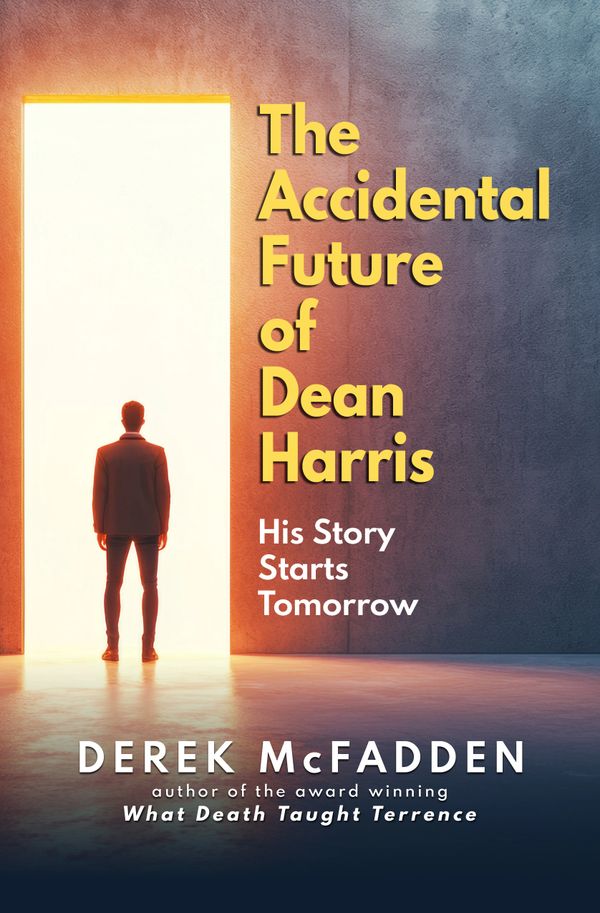
The beautiful cover image chosen for Dean Harris didn’t come about by accident—if only!
The image above is actually the one we put up on NetGalley. And we (author Derek, designer Mark, and publisher Jay) all agreed it was good. Great even. We loved how the brightly lit portal stood out thematically for the Dean’s story and pictorially for the cover.
Nailed it! Backslapping ensued. Until we heard from a more expanded reader research base that we um… didn’t nail it…
“Not sure what kind of book this is.”
“Is this book sci-fi?”
“Is Dean off on some kind of huge metaphysical journey?”
“Erm… I’m getting time travel?”
“This IS cool, but what kind of story are we getting?”
Thanks to all who kindly gave excellent feedback on social media and those readers who grabbed an ARC on NetGalley—yes, voting the cover down (67%) told us to reassess the cover, so thanks. Really.
Designer Mark had this to say. “It fit the brief so well. And graphically you can see how neatly the elements sit together, I hope. But… then you hated it! We talked a little bit about finding an image that was brighter, that might draw the reader in.”
We did.
Derek and his wife, Monica, really liked a previous iteration, where we had both Dean and Claire on it, suffused in cyan and red and yellow. “I loved the romantic feel of that one,” Derek said. “This portal looked so cool—I love that about it. But should we have Claire on it, like before?”
Turns out that was good insight. So, how would we fix it?
Jay: “Let’s make it about the couple, but have them smaller so it doesn’t scream romance. And let’s avoid all reds. And let’s find something pretty.”
Mark agreed, although he lamented how we might lose the strong glow of the portal. “Could we still keep that idea in some way and make it not suggest sci-fi?”
That was the challenge.
And then we found some old teal-and-yellow image. Begging us to use it :).
Come back soon and check out more cover iterations. Sneak peek: there were 4 major iterations before we got to the final one! You’ve seen here version 3 of the 5.
More soon...
Alternative cover concepts pt. 1
Alternative cover concepts pt. 1
Check back soon for images and artwork in the coming days and weeks.